
The Invisible Coup
How Migration Became a Geopolitical Weapon

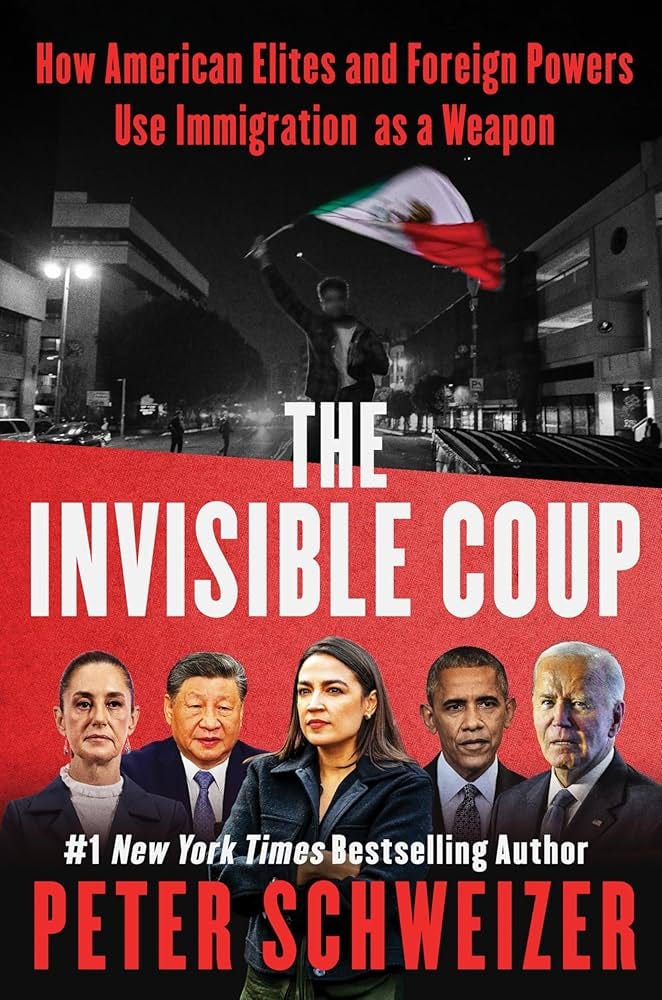
There are books that argue policy.
And then there are books that argue power.
The Invisible Coup: How American Elites and Foreign Powers Use Immigration as a Weapon by Peter Schweizer belongs firmly in the second category.
Schweizer’s thesis is blunt: migration is no longer merely a humanitarian issue or an economic debate. It is a strategic instrument—leveraged by adversarial regimes and enabled by American elites who either fail to recognize the game or benefit from playing it.
The audiobook, narrated by Charles Constant, delivers the material with steady urgency—less sensational than you might expect, more prosecutorial.
Chapter One: Castro’s Test Run
Schweizer opens in 1980.
Fidel Castro announces that anyone who wants to leave Cuba may do so from the port of Mariel.
What followed—known as the Mariel Boatlift—was not a spontaneous humanitarian exodus. According to Schweizer, it was a calculated geopolitical maneuver.
Tens of thousands arrived in Florida. Among them were not only ordinary Cubans, but prisoners and individuals released from psychiatric institutions. The sudden surge strained local infrastructure and reshaped domestic politics.
The key figure in this drama: Jimmy Carter.
Schweizer argues that Castro exploited Carter’s moral posture—testing whether the United States could be destabilized through controlled migration pressure. Washington, he suggests, was reactive, not strategic.
It was a rehearsal.
The San Paolo Strategy
From Cuba, the book widens its lens.
Schweizer highlights the San Paolo Forum—a coalition of leftist Latin American parties founded in 1990.
São Paulo Forum was formed by Luiz Inácio Lula da Silva and Castro in the aftermath of the Cold War.
Schweizer presents it as more than a conference circuit. In his telling, it is a network that coordinates political strategy across the hemisphere—including approaches to migration flows.
Whether one accepts that interpretation wholesale or not, the book pushes readers to consider something uncomfortable:
Are border crises purely accidental?
Or are they sometimes engineered?
Modern Actors, Modern Pressure Points
Schweizer expands beyond Latin America.
He argues that multiple global actors recognize migration’s destabilizing potential:
Mexico, positioned as both transit corridor and geopolitical lever.
China, which he claims exploits visa systems, technology flows, and demographic influence to advance strategic interests.
Radical Islamist networks, using refugee flows and asylum channels as infiltration opportunities.
Transnational NGOs and political elites who, in Schweizer’s view, amplify the effect—whether from ideology, profit, or institutional inertia.
The core claim isn’t that migrants themselves are enemies.
It’s that migration, at scale and under certain conditions, can function as asymmetric warfare.
That is the “invisible coup.”
Why the Book Matters
Schweizer’s critics will call it alarmist.
Supporters will call it overdue.
But here’s the sharper point:
He reframes immigration not as compassion versus cruelty—but as sovereignty versus strategic vulnerability.
And once you look at migration through that lens, it’s hard to unsee it.
The 1980 Mariel episode becomes a prototype.
The border surge becomes leverage.
Policy debates start to resemble power struggles.
Final Assessment
As a work of investigative political argument, The Invisible Coup is provocative, tightly constructed, and designed to challenge comfortable assumptions.
Whether you agree with every conclusion or not, Schweizer forces the question:
If adversaries openly discuss using migration pressure to weaken Western states… why would we assume they aren’t trying?
That alone makes the book worth reading—or listening to.
And if history has taught anything, it’s that the quiet strategies are often the most consequential.